Dr. Roger Eltringham, Anaesthetist, Gloucestershire Royal Hospital,
Gloucester.
Edited by D. R.
A reliable
source of oxygen is essential wherever oxygen or ozone therapies are
considered. Oxygen is traditionally supplied in cylinders which are
both bulky and expensive. In isolated areas transportation of cylinders
is difficult and many clients attempting to use oxygen in their homes
find difficulties associated with obtaining oxygen and storage of pressurized
oxygen tanks not appealing, dangerous or impossible. In many parts
of the world the supply of oxygen may fail altogether leaving the user
of ozonation system without any means how to produce pure ozone.
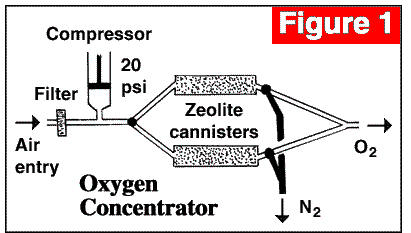 Atmospheric
air consists of approximately 80% nitrogen (Atomic weight 14.00674)
and 20% oxygen (Atomic weight 15.9994). An oxygen concentrator uses
ambient air as a source of oxygen by separating these two components.
In the oxygen concentrator the nitrogen is absorbed by the Molecular
Sieve when under pressure and released from the Molecular Sieve when
the pressure is released. This process is based on a property of Zeolite® granules
to selectively absorb nitrogen from compressed air. (Zeolite is a trade
name for one of the special granulated materials which can be used
as a fill for Molecular Sieve). Atmospheric air is entrained by the
concentrator (Fig 1), filtered and raised to a pressure of 20 pounds
per square inch (P.S.I.) by a compressor. The compressed air is then
introduced into one of the canisters containing Zeolite granules where
nitrogen is selectively absorbed leaving the residual oxygen available
for patient use. After about 20 seconds the supply of compressed air
is automatically diverted to the second canister where the process
is repeated enabling the output of oxygen continue uninterrupted. While
the pressure in the second canister is at 20 P.S.I. the pressure in
the first canister is reduced to zero. This allows nitrogen to be released
from the Zeolite and returned into the atmosphere. The Zeolite is then
regenerated and ready for the next cycle. By alternating the pressure
in the two canisters so that first one and then the other is at 20
P.S.I., a constant supply of oxygen is produced while the Zeolite is
continually being regenerated. Individual units have an output in range
1/ 4 to 5 liters per minute [LPM] with an oxygen concentration usually
in range of 90 - 95%. Atmospheric
air consists of approximately 80% nitrogen (Atomic weight 14.00674)
and 20% oxygen (Atomic weight 15.9994). An oxygen concentrator uses
ambient air as a source of oxygen by separating these two components.
In the oxygen concentrator the nitrogen is absorbed by the Molecular
Sieve when under pressure and released from the Molecular Sieve when
the pressure is released. This process is based on a property of Zeolite® granules
to selectively absorb nitrogen from compressed air. (Zeolite is a trade
name for one of the special granulated materials which can be used
as a fill for Molecular Sieve). Atmospheric air is entrained by the
concentrator (Fig 1), filtered and raised to a pressure of 20 pounds
per square inch (P.S.I.) by a compressor. The compressed air is then
introduced into one of the canisters containing Zeolite granules where
nitrogen is selectively absorbed leaving the residual oxygen available
for patient use. After about 20 seconds the supply of compressed air
is automatically diverted to the second canister where the process
is repeated enabling the output of oxygen continue uninterrupted. While
the pressure in the second canister is at 20 P.S.I. the pressure in
the first canister is reduced to zero. This allows nitrogen to be released
from the Zeolite and returned into the atmosphere. The Zeolite is then
regenerated and ready for the next cycle. By alternating the pressure
in the two canisters so that first one and then the other is at 20
P.S.I., a constant supply of oxygen is produced while the Zeolite is
continually being regenerated. Individual units have an output in range
1/ 4 to 5 liters per minute [LPM] with an oxygen concentration usually
in range of 90 - 95%.
Routine maintenance
consists merely of changing the filters at regular intervals as directed
by the manufacturers and this can be easily achieved using skills available
locally. Providing these recommendations are observed the unit requires
no other attention and will continue to function for many years. With
its record of dependability, ease of maintenance and minimal running
costs the initial purchase price is usually considered an excellent
investment and will rapidly lead to great savings of money.
|


 The
Oxygen Concentrator
The
Oxygen Concentrator 

 Home
> Articles > The Oxygen Concentrator
Home
> Articles > The Oxygen Concentrator